Unilabs AI Centre of Excellence
AI in radiology, implemented with purpose
At TMC, AI is used to support radiologists—not replace them.
Our Clinical AI Centre of Excellence helps identify, evaluate and integrate clinically meaningful AI tools that improve workflows, support reporting and strengthen diagnostic quality. For radiologists, this means working in a clinically progressive environment where innovation is implemented thoughtfully, responsibly and with real-world reporting in mind.

Dr Geraldine Dean, Head of AI Implementation
AI in daily radiology practice
AI-supported workflows currently help support:
Acute case prioritisation
AI helps flag urgent findings to support timely workflow escalation and prioritisation.
Thoracic imaging workflows
AI tools support detection of key thoracic pathologies and incidental findings.
Brain CT review support
AI assists in the detection of acute brain pathologies, including aneurysm and large vessel occlusion pathways.
Pulmonary embolism detection pathways
AI supports detection workflows for pulmonary embolism in both dedicated CTPA and incidental thoracic imaging pathways.
Lung nodule pathways
AI supports lung nodule detection in both screening and incidental imaging settings.
These tools are integrated thoughtfully to support efficiency and workflow prioritisation while keeping radiologists firmly in control of clinical decision-making.
AI + Optemis: Built into the workflow
AI is most valuable when it fits naturally into the reporting environment.
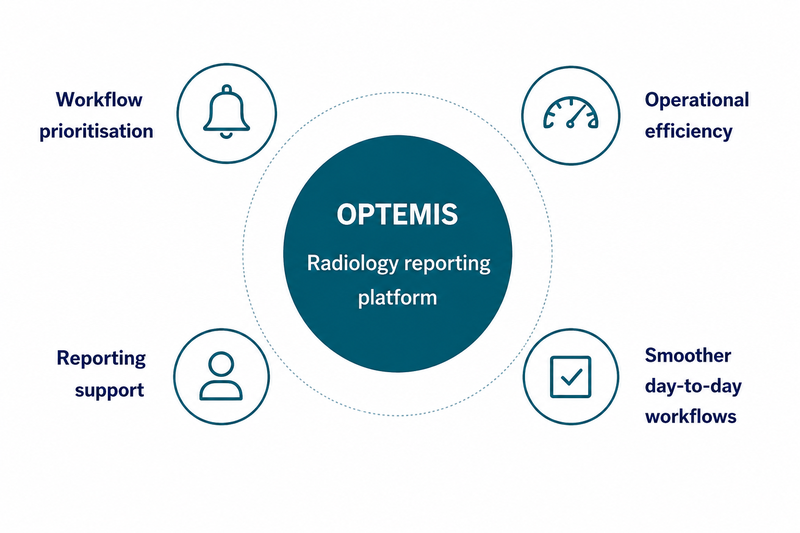
TMC integrates AI within Optemis, our proprietary radiology reporting platform, helping ensure AI supports practical workflow needs rather than adding complexity.
Innovation should feel useful, not disruptive.
This allows clinically meaningful AI insights to contribute to:
- ◦ workflow prioritisation
- ◦ operational efficiency
- ◦ reporting support
- ◦ smoother day-to-day workflows
A multidisciplinary team shaping clinical AI in radiology
The AI Centre of Excellence combines practising radiologists, clinical leadership and technical AI specialists working together to ensure innovation remains practical, clinically relevant and radiologist-focused.
Dr Geraldine Dean, Clinical AI Lead
Dr Geraldine Dean combines consultant radiology practice with extensive international experience in clinical AI implementation, governance and healthcare innovation. Her work focuses on helping ensure AI is introduced responsibly within real reporting environments, supporting radiologists through clinically meaningful workflow improvement.
Her wider roles include:
- ◦ Royal College of Radiologists AI Advisory Committee Member
- ◦ NHS Artificial Intelligence Clinical Lead
- ◦ AI Clinical Lead, Unilabs AI Centre of Excellence
Dr Björn Jobke, Clinical AI Lead Radiologist

Dr Björn Jobke works at the intersection of musculoskeletal radiology, pathology and AI-supported diagnostics.
With a background spanning both bone pathology and radiology, his approach focuses on integrated diagnostics, collaboration and clinically relevant workflow innovation.
Alongside his ongoing MSK radiology practice, he works closely with colleagues to explore how AI can support imaging workflows through practical, ethically responsible implementation that keeps radiologists central to clinical decision-making.
Dr Stavroula Kyriazi, Clinical AI Lead Radiologist

Dr Stavroula Kyriazi is a consultant radiologist specialising in oncologic and emergency imaging, with a strong interest in AI-supported diagnostics and radiomics.
Her work focuses on clinically meaningful AI adoption, helping support radiologists through practical workflow innovation, collaboration and modern digital imaging practice.
Alongside her reporting work at TMC, she contributes to wider multidisciplinary healthcare and AI advisory initiatives.
Ernest Montana, AI Manager Clinical Applications

Ernest Montana leads operational AI implementation across radiology and pathology environments, helping oversee evaluation, workflow integration, rollout and performance monitoring.
His work spans the full lifecycle of clinical AI implementation—from solution evaluation and validation through to deployment and ongoing optimisation within real clinical workflows.
How we approach clinical AI
The AI Centre of Excellence supports the full lifecycle of clinical AI implementation—from identifying promising technologies through to deployment, monitoring and education.

AI solution scouting and evaluation
We assess emerging AI tools for genuine clinical relevance, practical usability and meaningful workflow benefit.

Validation and comparative studies
We review how tools perform in real reporting environments—not just under ideal test conditions.

Clinical implementation and deployment support
We help integrate clinically valuable AI into operational workflows designed around radiologists.

Training and knowledge sharing
We support education, collaboration and shared learning across radiology teams.

Performance and impact monitoring
We continuously review usability, workflow impact and clinical value to ensure tools continue to add meaningful support.
A clinically progressive environment
For radiologists interested in the future of imaging, TMC offers the opportunity to work in an environment where innovation is implemented thoughtfully and responsibly.
This includes exposure to:
- ◦ clinically governed AI implementation
- ◦ modern reporting workflows
- ◦ evolving workflow innovation
- ◦ collaboration between clinical and technical experts
AI is changing radiology.
Working in the right environment helps ensure that change is positive.

EXPLORE RADIOLOGY CAREERS IN A CLINICALLY PROGRESSIVE ENVIRONMENT
Join a radiology network where innovation is implemented with purpose, clinical leadership and respect for the realities of modern reporting.
➜ Explore radiology opportunities
➜ Meet our clinical leadership team